
The McKinsey Global Institute just dropped their latest AI report for 2025 and honestly? It’s the first one in a while that actually made me stop doom-scrolling and take notes. The big shift this year isn’t just “AI is getting better” (we all know that). It’s that agentic AI — those systems that can plan, reason, and take actions on their own — is finally moving from PowerPoint hype to something companies are actually budgeting for.
I’ve been digging through McKinsey reports since the 2017 “AI will eat jobs” era, and this one feels different. Less hand-wringing, more “here’s what’s working right now.” So I read the full 150+ pages (you’re welcome) and pulled out the stuff that actually matters for anyone running a business, leading a team, or just trying to figure out if your job’s safe.
Agentic AI Is the New Black (And It’s Not Just Chatbots Anymore)
Remember when everyone was freaking out about generative AI stealing creative jobs? Yeah, that was 2023. The 2025 report basically says: cool story, but the real money and productivity is coming from AI agents that can do full workflows.
We’re talking systems that don’t just answer questions — they book meetings, negotiate with vendors, reconcile invoices, run A/B tests, and even write the Slack update about what they just did. McKinsey estimates that by 2030, 75% of Fortune 500 companies will be using some form of multi-agent systems. Not pilots. Production.
One example that stuck with me: a large bank using AI agents reduced loan processing time from 10 days to under 4 hours. Not because they hired more people — they literally fired the middle-manager bottleneck and let agents handle the exceptions.
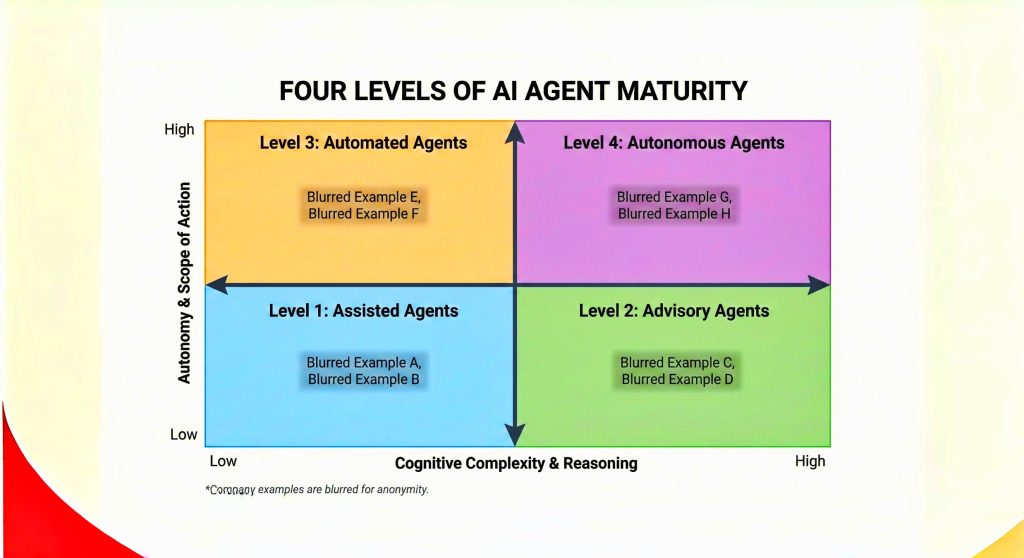
The Four Levels of AI Agents (McKinsey’s Framework)
McKinsey breaks agents into four maturity levels. Most companies are still stuck at Level 1 or 2:
- Level 1: Reactive assistants (think current ChatGPT plugins)
- Level 2: Goal-oriented agents (can complete multi-step tasks with human approval)
- Level 3: Autonomous agents (operate independently within guardrails)
- Level 4: Multi-agent organizations (teams of specialized agents that coordinate like humans)
Only about 1% of companies are at Level 3 today. But the ones that get there first? They’re seeing 30-50% productivity gains in knowledge work. That’s not incremental. That’s “we just laid off an entire department” territory.
The Economic Impact Numbers Are Actually Insane
Here’s where it gets wild. McKinsey’s baseline scenario now projects AI could add $25.6 trillion to global GDP by 2040. That’s more than the current size of the US + China economies combined.
But the part that made me spit coffee: 70% of that value comes from agentic systems, not generative AI alone.
| Area | Projected Value by 2040 | Biggest Winners |
|---|---|---|
| Customer service | $4.4 trillion | Retail, telecom, financial svcs |
| Software development | $3.8 trillion | Tech obviously, but also everyone who writes code now |
| Operations & supply chain | $5.2 trillion | Manufacturing, logistics |
| R&D and product dev | $4.1 trillion | Pharma, automotive, consumer goods |
The craziest stat? Companies that adopt agentic AI early could see 3-5x higher productivity growth than late adopters. We’re talking the kind of gap that killed Blockbuster vs Netflix, but in two years instead of ten.
If you want to see someone way smarter than me break this down, this video from the McKinsey team themselves is surprisingly watchable:
Where Most Companies Are Screwing This Up Right Now
I talk to a lot of execs who are throwing money at “AI transformation” and getting almost nothing. The report calls out three big traps:
- Treating agents like chatbots — You can’t just slap a better prompt on Claude and call it an agent. These systems need memory, tools, planning modules, and verification loops.
- No governance, no trust — 63% of failed agent projects died because humans didn’t trust the outputs. The winners have “human-in-the-loop” only for high-stakes decisions.
- Starting with the sexy stuff — Everyone wants an AI CEO (lol). The companies crushing it started with boring back-office processes that nobody cares about until they save millions.
Real example: A logistics company I know automated 80% of their freight auditing with agents. Sounds boring. Saved them $180 million last year. Now they’re working their way up to the fun stuff.
The Talent Crunch Is Real (And Getting Worse)
Here’s the part nobody wants to talk about: we don’t have enough people who actually know how to build these systems.
McKinsey says demand for “AI orchestrators” — the people who design agent workflows and guardrails — will grow 40x by 2030. Right now there are maybe 50,000 people globally who can do this well. Math is not mathing.
So What Should You Actually Do Monday Morning?
Don’t boil the ocean. The report has a pretty solid playbook:
- Pick one high-volume, rule-heavy process (think invoice processing, customer onboarding, basic legal review)
- Start with Level 2 agents (goal-oriented, human approval required)
- Build the data plumbing first (agents break without clean, connected data)
- Create an “agent center of excellence” with 3-5 people who obsess over this full-time
The companies winning right now aren’t the ones with the biggest budgets. They’re the ones moving fastest on the boring foundational sh*t.

Yeah, But What About the Jobs Thing?
McKinsey softened their tone from 2017 when they said 800 million jobs would disappear. Now they’re saying 30% of work activities could be automated by 2030, but most of that creates new types of work.
The report actually has this great quote:
“Every previous automation wave created more jobs than it destroyed. The difference now is speed.”
Translation: Your job probably isn’t going away, but it’s definitely changing. The people who learn to work with agents will crush the ones fighting them.
Key Takeaways (The Actual TLDR)
- Agentic AI is the main event now — generative was just the opening act
- Early adopters are seeing 30-50% productivity gains in knowledge work
- 70% of AI’s economic value comes from agents, not chatbots
- Start small, start boring, move fast
- The talent bottleneck is the real constraint, not technology
- This isn’t 2030 stuff — companies are making money with Level 3 agents today
FAQ
Q: Is it McKinsey selling more consulting?
A: Look, they’re consultants. Naturally there is a certain degree of self-interest. But the figures here are consistent with what I am observing in actual companies i.e. the agent maturity rates and the productivity rates.
Q: Will we all be substituted with AI agents?
A: Not replaced. Augmented. The individuals who learn how to delegate successfully to agents will enjoy enormous leverage. Those who do not, well, Blockbuster also had VCRs.
Q: What is the dissimilarity between an AI agent and simply utilizing Zapier + ChatGPT?
A: Night and day. Zapier automates triggers. Agents are able to deal with ambiguity, make decisions and correct course in case of failures. Consider intern as compared to senior manager.
Q: What industries are the most rapid in this?
A: Financial services (in particular, insurance), and, surprisingly enough, legal tech. Law firms that are hiring agents to review contracts are eating all of our lunch.
Q: Wait before the technology is improved?
A: The waiting companies are those that were trampled by cloud in 2010. The technology is sufficient enough to save actual finances on actual procedures.
Q: In which place can I find the actual report?
A: McKinsey offered the executive summary as free, but the full contents are behind their standard “give us your soul (email) wall. Worth it though.
The 2025 report is the one that makes me feel that the process of AI turning into an actual business transformation is real. And it is chaotic and unslick and somewhat frightening. But mostly? It is the biggest chance that most of us are going to get in our careers. Don’t sleep on this one.