
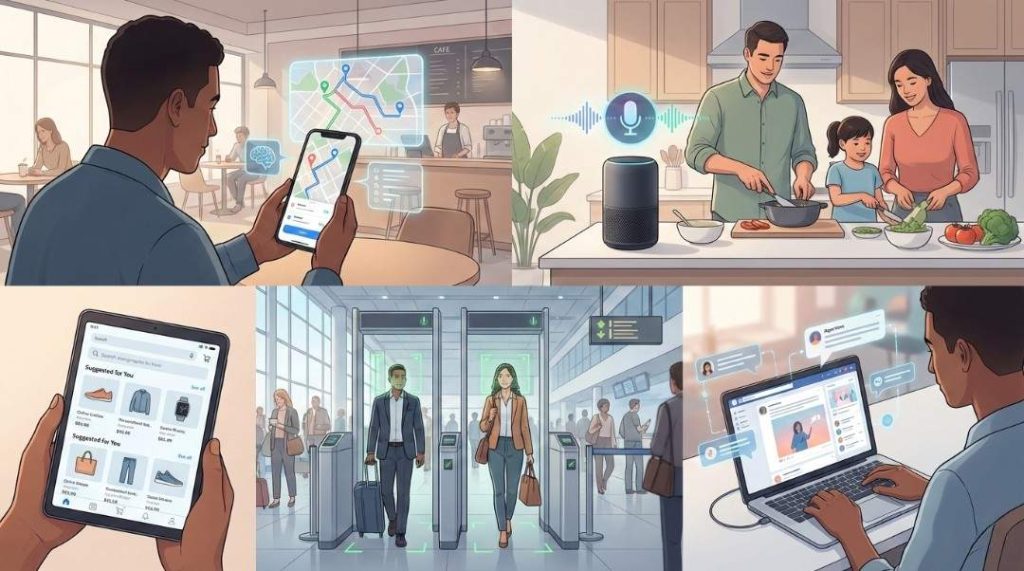
You start your day with a voice command to a smart speaker for the weather. You drive to work guided by an app that magically knows about a traffic jam two miles ahead. At lunch, you scroll through a social media feed that seems to read your mind. And at the end of it all, you might tell a friend, “I don’t really use that much AI stuff.”
If that sounds like you, you’ve got plenty of company. There’s a fascinating disconnect happening in America right now. We’re living in an AI-saturated world, yet most of us are completely unaware of just how deep it goes. Think about it: while only 33% of people believe they use AI technology, a whopping 77% are actually using an AI-powered service or device. That’s not a small gap—that’s a chasm.
The truth is, AI has stopped being a sci-fi concept and has become the quiet, helpful, and sometimes creepy roommate in our daily lives. We interact with it dozens, maybe hundreds, of times a day. We just don’t call it by its name. And maybe that’s the point. The most powerful technology isn’t the one that announces itself with a flashy robot; it’s the one that fades so perfectly into the background you forget it’s there at all.
The Great AI Awareness Gap
Let’s cut to the chase with some numbers that really tell the story. A major Gallup study asked Americans a simple question: Have you used an AI-enabled product in the past week? Only 36% said yes. Seems reasonable, right? Maybe you haven’t fired up ChatGPT to write a sonnet lately.
But then the researchers asked a different, more specific question. They listed six common products: personal virtual assistants (like Siri or Alexa), navigation apps, weather apps, social media, streaming services, and online shopping sites. They asked people if they’d used those in the past week.
The result was staggering: 99% of U.S. adults had used at least one. Nearly everyone.
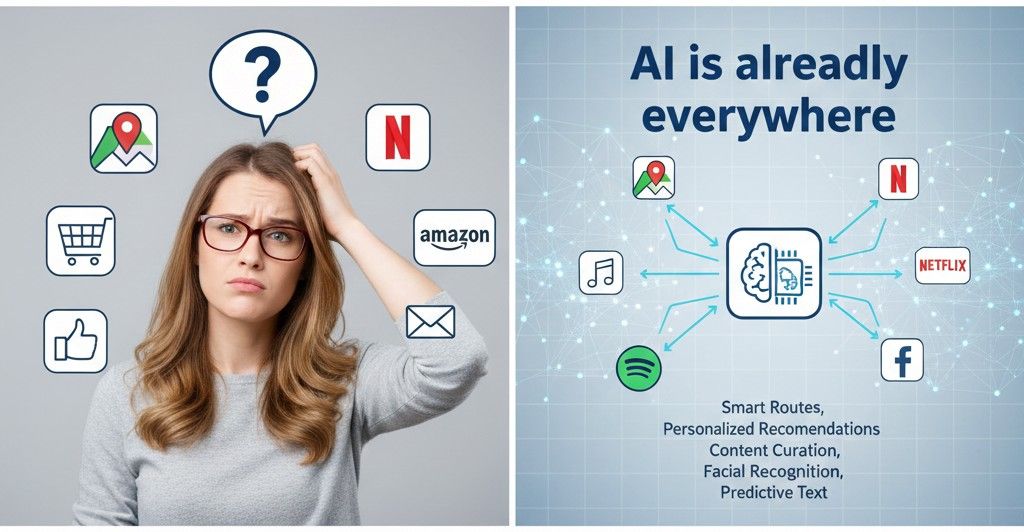
This is the core of the issue. We have a narrow, Hollywood-inspired idea of what AI is—humanoid robots, supercomputers taking over the world. We don’t recognize it in the mundane, helpful tools that route us around traffic, recommend our next show, or filter spam from our inbox. This gap between perception and reality shapes everything from our personal habits to our national policy debates.
Your Invisible Digital Assistant
You don’t need a robot butler to have AI serving you. It’s already embedded in the devices you carry and the websites you visit, working 24/7.
The Tech in Your Pocket and Your Home
Your smartphone is a pocket-sized AI powerhouse. That face unlock feature that recognizes you in a hat or with glasses? That’s AI. The autocorrect that sometimes hilariously butchers your texts but often gets them right? AI learning your personal slang. When you ask Siri, Google Assistant, or Alexa to set a timer, play a song, or add milk to the shopping list, you’re not just using a recorded voice—you’re engaging with a complex AI system that parses natural language to fulfill your request.
At home, it goes further. A smart thermostat like Nest learns your schedule and adjusts the temperature to save energy when you’re out. Robot vacuums map your floor plan and navigate around chair legs. Even your streaming service is an AI curator. Netflix and Spotify don’t just throw content at you; their algorithms analyze every pause, skip, and rewatch to build a profile of your taste that’s scarily accurate.
“While nearly all U.S. adults report using products with AI features, most do not realize that common apps, sites and web tools such as weather forecasting, navigation and online shopping use AI technology.” – Gallup & Telescope Study
AI on the Road and In Your Wallet
Getting from point A to point B is now an AI-assisted journey. Google Maps, Waze, and Apple Maps are constantly crunching real-time location data from millions of phones to paint a live picture of traffic flow. They don’t just show you a static map; they predict slowdowns, calculate your ETA, and suggest faster alternatives before you even see brake lights.
Behind the scenes, AI is also guarding your money. Your bank’s fraud detection system uses machine learning to understand your normal spending patterns—your regular coffee shop, your typical grocery store. When a transaction pops up that doesn’t fit, like a sudden large purchase in another state, the AI can flag it instantly, often declining it and texting you for verification before you even know something’s wrong.
AI at Work: The Silent Colleague
The office is where AI’s quiet integration is accelerating fastest, and it’s creating a new kind of workplace dynamic.
The Tools We Use (and Misunderstand)
AI use at work is rising sharply. In just a few months in 2025, the percentage of U.S. employees using AI at work jumped from 40% to 45%. But here’s the kicker: there’s often a stunning lack of awareness about a company’s own AI strategy. In one survey, 23% of employees admitted they simply didn’t know if their organization had implemented AI to improve productivity. This suggests many people are using personal AI tools or company-provided software without recognizing the “AI” behind it.
So, what are people actually doing with it? The most common uses are brilliantly practical:
- Consolidating information (42% of workplace AI users)
- Generating ideas and brainstorming (41%)
- Learning new things (36%)
These aren’t tasks that replace humans; they’re tasks that augment our thinking, taking the grunt work out of research and helping us overcome the blank page.
When Company Goals and Worker Needs Don’t Match
Stanford researchers uncovered an awkward truth by comparing what workers want from AI with what companies are actually implementing. They found a significant mismatch.
| What Workers Want AI To Do | What Companies Often Automate Instead |
|---|---|
| Repetitive, boring tasks (scheduling, filing, data entry) | Creative tasks (writing, designing) |
| Monitoring budgets and expenses | |
| Catching and fixing errors | Client communication & analysis |
| Freeing up time for human interaction |
Workers desperately want a digital assistant to handle the drudgery, freeing them up for the creative, relational work they enjoy. Yet, businesses, perhaps drawn to flashier applications, sometimes try to automate the very tasks employees want to keep. This disconnect can fuel resentment and slow down adoption, even as the technology becomes more common.

The Double-Edged Sword: Convenience vs. Concern
It’s not all smooth sailing and helpful recommendations. As AI weaves itself deeper into the fabric of daily life, Americans are expressing real and growing concerns. The overall mood is more wary than enthusiastic.
What Worries Us
The optimism gap is real. Globally, countries like China and Indonesia are overwhelmingly positive about AI’s benefits. In the U.S.? Only 39% of Americans believe AI products offer more benefits than drawbacks. Our top concerns are clear:
- The Spread of False Information: 72% believe AI will have a negative impact here.
- Eroding Social Connections: 64% think it will harm how we relate to each other. Half of Americans even believe AI will make us worse at forming meaningful relationships.
- Job Displacement: 60% foresee a negative effect on job opportunities.
There’s also a deep and growing distrust of how AI companies handle our data. A global survey found confidence that these companies protect personal information is actually falling. It’s a valid fear. As one Stanford expert warned, the conversations you have with an AI chatbot aren’t necessarily private; they could be used to train future models, and that data can be combined with everything else the tech giant knows about you.
Who We Think Should Fix It
Americans are largely united on one thing: someone needs to be in charge. There’s a strong consensus that both government and business leaders bear responsibility for managing AI’s risks. A huge 96% say the government has a role in reducing national security threats from AI. When it comes to job losses, however, people see businesses as having the primary duty to address the harm.
Yet, at the individual level, the sense of personal accountability is surprisingly low. Only about half of Americans feel a high level of personal duty to use AI responsibly. Among younger adults—the heaviest users—that sense of responsibility is even lower. It’s as if we see the technology as a force of nature, shaped by big institutions, rather than a tool whose impact is also shaped by our own daily choices.
For a deeper look at how these tools are built and the data that powers them, this explainer on how AI systems are trained is incredibly insightful.
Living With Your New Roommate
So, where does this leave us? We’re in a relationship with a technology we don’t fully see and don’t entirely trust, yet we can’t seem to live without its conveniences. The path forward isn’t about rejecting AI—that ship has sailed. It’s about developing a sharper, more conscious relationship with it.
Start by opening your eyes to the AI you already use. The next time you get a scarily accurate product recommendation or a traffic alert saves you 20 minutes, acknowledge the intelligence at work. Be a more informed consumer of technology. Read the privacy policies, use the opt-out settings for data training where they exist, and think twice before sharing sensitive personal information with a chatbot.
The goal shouldn’t be to fear the invisible assistant, but to understand its role. We should demand the things we want from it—like taking over mundane tasks—and push back when it encroaches on the deeply human work we value. The future isn’t about humans versus AI. It’s about figuring out how to live well with a powerful, invisible, and permanent new roommate.
Key Takeaways
- The Awareness Gap is Huge: While 99% of Americans use AI-powered products weekly, only about a third realize they’re doing so. AI is defined by its helpfulness, not by a robotic appearance.
- It’s Embedded in Daily Routines: From voice assistants and traffic apps to spam filters and fraud detection, AI works invisibly in the background of common tools.
- Workplace Use is Growing but Awkward: Nearly half of employees now use AI at work, often to consolidate information or generate ideas. However, a mismatch between what workers want automated and what companies implement can cause friction.
- Optimism is Low, Concern is High: Americans are more concerned than excited about AI’s societal impact, particularly regarding misinformation, social connections, and jobs.
- Responsibility is Seen as Institutional: The public largely believes government and business leaders, not individuals, are responsible for managing AI’s risks and harms.
Frequently Asked Questions (FAQs)
I don’t use ChatGPT. Am I still using AI?
Almost certainly. If you use a navigation app like Google Maps, shop on Amazon, scroll through Netflix or Instagram, or even just have a smartphone with autocorrect, you are interacting with AI daily. Generative AI chatbots are just one very visible slice of a much larger pie.
What’s the most common way people use AI without knowing it?
One of the most universal yet invisible uses is through search engines and social media algorithms. When you type a query and Google suggests the rest, or when your Instagram feed seems perfectly tailored to your interests, that’s AI analyzing patterns and predicting what you want to see.
Are young people more aware of using AI?
They use it more, but awareness is still mixed. Adults under 30 are far more likely to have heard a lot about AI and to use generative AI tools weekly. However, studies show they also hold some of the most negative views about its impact on jobs and are less likely to feel personal accountability for using it responsibly.
Should I be worried about my privacy with all this hidden AI?
It’s a valid concern. Major studies show public trust that AI companies will protect personal data is declining. Experts advise being cautious about what personal or sensitive information you share with AI chatbots, as this data is often used for training. It’s wise to check privacy settings and opt-out options where available.
How is AI affecting jobs right now?
Currently, AI in the workplace is more about augmentation than replacement. Most employees use it as a tool to help with parts of their jobs, like research, drafting, and organizing information. The fear of full job displacement is still greater than the current reality for most roles, though the anxiety is understandable and widespread.
What’s one positive impact of AI that gets overlooked?
Healthcare and medical diagnosis. Despite general skepticism, this is one area where Americans are relatively optimistic about AI’s potential. AI is already being used to analyze medical scans, predict disease outbreaks, and assist in drug discovery, often with the goal of catching illnesses earlier and more accurately.