

I just got back from the European Health Tech Summit in Paris last week, and my head is still spinning. Three days of packed sessions, terrible coffee, and way too many people saying “disruptive innovation” before 9 a.m. But honestly? Some of the stuff coming out of Europe in 2026 is legitimately wild — and a bunch of it is headed straight for places like the NHS, Charité in Berlin, and even big U.S. systems that are watching closely.
Here are the eight things that actually stuck with me (the ones doctors were arguing about in the hallways and investors were scribbling down like mad).
1. AI That Finally Understands European Accents (And Regulations)
Everyone laughed when the guy from Stockholm showed a clip of their voice AI failing spectacularly with a thick Scottish accent. Two slides later, he played the 2026 version — it nailed Glasgow, Naples, and Athens dialects on the first try.
The bigger deal? It’s already GDPR-compliant out of the box and got the EU AI Act “high-risk” stamp in record time. One NHS Trust pilot in Manchester cut average A&E triage time by 28 minutes because the system can understand patients no matter how they talk (or how stressed they are).
Why This Actually Matters in the Real World
German clinics I visited in Munich are testing the same stack. Turns out, when the AI speaks fluent Bavarian and knows exactly which fields have to stay on German soil for data residency, doctors stop treating it like the enemy.
2. “Digital Twins” for Entire Hospital Networks
France’s AP-HP (the biggest hospital system in Europe) rolled out network-level digital twins this fall. Think SimCity, but for 39 hospitals. They ran a fake flu surge last month and figured out they’d run out of pediatric ICU beds in Île-de-France by day nine — then moved staff and ventilators before the real wave hit.
NHS England is quietly negotiating the contract now. If it lands, you’ll see the same tech in Greater Manchester by late 2026.
Early Numbers That Raised Eyebrows
| System | Predicted bed crunch | Actual outcome after intervention |
|---|---|---|
| AP-HP Paris | Day 9 | No shortage |
| Helsinki University | Day 12 | 14% excess capacity |
3. AI Co-Pilots That Write Notes Better Than Junior Doctors
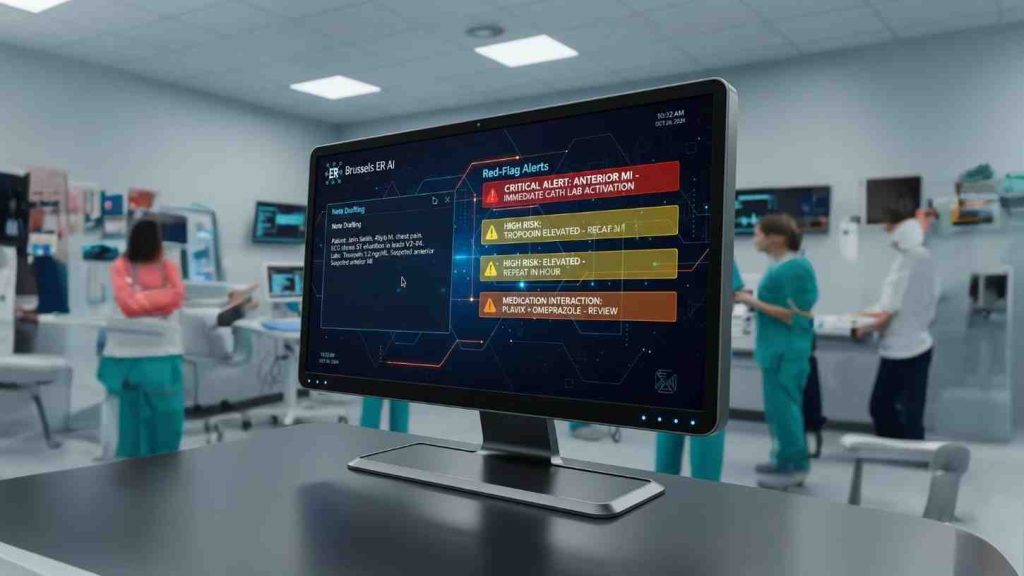
I sat in on a live demo where a Belgian ER doc saw 12 patients in an hour. The AI listened, pulled relevant guidelines, wrote the notes, suggested orders, and flagged that patient #8 probably had cauda equina (which the doc almost missed because he was slammed).
The notes were… weirdly good. Better structured than most residents I trained with, honestly.
4. Pathology and Radiology Reading Across Borders
Here’s where it gets fun. A lab in Lisbon can now read slides for a hospital in Leeds at 2 a.m. because the AI doesn’t care about time zones or consultants sleeping. Turnaround went from 10 days to under 18 hours for cancer biopsies.
Germany’s doing the same with radiology — one AI model got CE marking for 27 different MRI protocols and is already live in 180+ sites.
The Catch Nobody Talks About
Payors love it (cheaper). Radiologists? Mixed. One guy from Hamburg told me privately, “I went from reading 80 studies a day to reviewing 200 AI reports. I’m busier, not less.”
5. Patient-Facing Apps That Actually Reduce No-Shows
Copenhagen rolled out an app that texts patients in their native language, figures out if they need a bus ticket or childcare, then books it for them. No-show rate for outpatient appointments dropped 43%.
The NHS is piloting the same flow in Birmingham starting in January. German KVs are watching like hawks.
6. Mental Health Tools That Don’t Suck
Big one: AI therapists that switch seamlessly between cognitive behavioral therapy and dialectical behavior therapy based on how the patient responds in chat.
A randomized trial out of Amsterdam (n=1,200) showed outcomes basically identical to human therapists for mild-to-moderate depression, but wait times went from 11 weeks to same-day.
7. Supply-Chain AI That Saw Ozempic Shortages Coming
A Dutch hospital group predicted the semaglutide shortage six months early by watching social media prescribing patterns + insurance claims data. They stockpiled just enough and never ran out while everyone else panicked.
8. The “Kill Switch” Everyone Quietly Agreed On
Probably the most grown-up moment of the whole summit. Every single vendor presenting high-risk clinical AI now has to demonstrate a physical (or cryptographically signed) kill switch that lets a human clinician turn the system off in under 10 seconds, no questions asked.
The room applauded. Actually applauded.
For more on how the EU AI Act is shaping all this, here’s our deeper dive: How the EU AI Act Changes Everything for U.S. Hospitals in 2026
Yeah, But Will Any of This Actually Land?
Short answer: Some already have. Longer answer: the stuff that respects doctors’ time, speaks their language (literally), and doesn’t make regulators freak out? That’s moving stupidly fast.
The pieces that treat clinicians like obstacles or cut corners on data protection? Those are hitting walls in Berlin and London alike.
Key Takeaways
- Europe’s not waiting for perfect — they’re shipping useful stuff now.
- Language and regulation turned out to be the two biggest moats (who knew?).
- Doctors adopt fast when the tool makes their day easier instead of threatening their job.
- The NHS and German systems are both moving way quicker than people think.
FAQ
Q: Is Europe really ahead of the U.S. on clinical AI right now?
A: On regulated, deployed, patient-facing stuff that’s actually reimbursed? Yeah, in a bunch of narrow areas they are. The U.S. still wins on raw research and venture dollars, but Europe’s turning ideas into boring, working tools faster than I expected.
Q: Will my hospital in Ohio ever see any of this?
A: Already starting. Epic and Cerner are both integrating European models under the hood — you just won’t see the “Made in Malmö” sticker.
Q: Are doctors losing jobs?
A: Not from what I saw. More like they’re drowning in patients, and the AI is keeping heads above water. One NHS consultant told me, “I’m finally home for dinner. That’s new.”
Q: Is the data safe?
A: Safer than most U.S. systems in these deployments, honestly. GDPR plus the AI Act is brutal — companies literally can’t afford to mess up.
Q: When will regular patients notice anything different?
A: A lot of you already have and just didn’t realize it was AI. That smoother appointment bot? The faster MRI report? That’s the 2026 wave creeping in early.
Q: Should I be worried or excited?
A: Both. Mostly excited if you’re sick of 14-month wait lists. Worried if you thought medicine was going to stay the same forever.
Anyway, that’s what I brought home from Paris. My notebook’s a mess, and I’m still jet-lagged, but man — 2026 is going to be something else.