
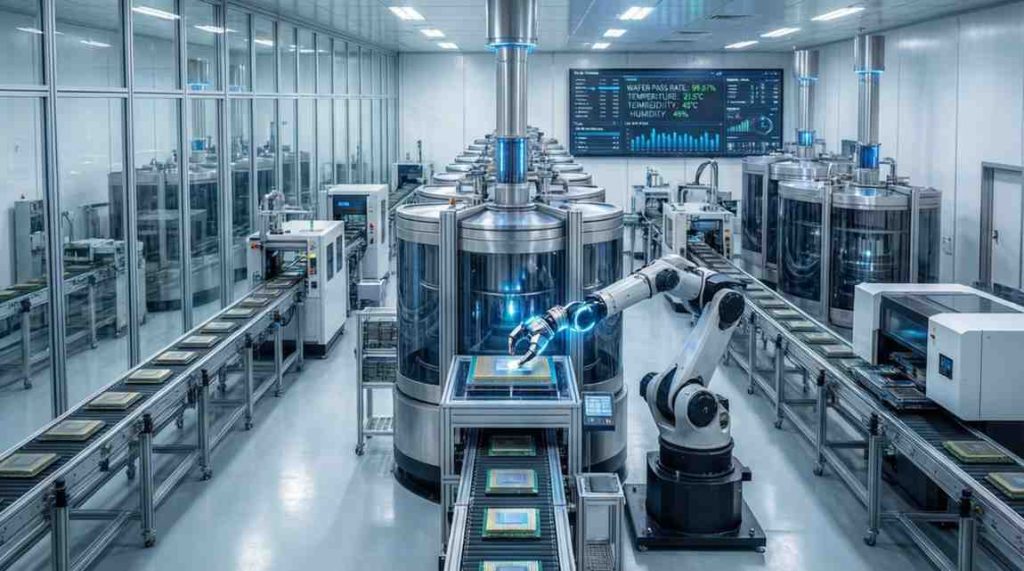
You know, it’s wild how fast things have ramped up in the tech world lately. Just a couple years back, AI was this buzzword floating around conferences, but now? It’s driving massive AI chip demand for TSMC, the Taiwanese giant that’s basically the backbone of advanced semiconductors. They’re cranking out chips for everyone from Nvidia to Apple, and with AI exploding, TSMC’s riding high. But here’s the thing—amid all this hype, whispers about an AI bubble are getting louder. Could it pop and leave TSMC scrambling? Let’s dig into that, because if you’re following tech stocks or just curious about where this is headed, it’s worth paying attention.
The Boom in AI Chip Demand for TSMC
TSMC, or Taiwan Semiconductor Manufacturing Company, isn’t just any chipmaker—they’re the go-to for the most cutting-edge stuff. And right now, AI chip demand for TSMC is through the roof. We’re talking about chips that power everything from ChatGPT-like models to self-driving cars. It’s not hype; it’s real business pouring in.
What’s Fueling This Massive Growth?
A few big drivers stand out. First off, big tech companies like Google and Microsoft are pouring billions into AI infrastructure. They need more powerful chips to train massive models, and TSMC’s advanced nodes—like 3nm and 2nm—are perfect for that. High-performance computing, which includes AI, made up over half of TSMC’s sales last quarter. Then there’s the push for edge AI, where devices like phones run smarts locally, boosting demand even more.
But it’s not all smooth. I’ve seen how these trends can shift—remember when crypto mining spiked chip needs, then tanked? AI feels more solid, but you never know. Analysts at Counterpoint Research are calling 2026 a “breakout year” for AI servers, which could keep pushing AI chip demand for TSMC upward.
Table of Contents
TSMC’s Recent Wins and Numbers
Wrapping up 2025, TSMC smashed expectations. Their fourth-quarter profit jumped 35% to about $16 billion, with revenue hitting over $33 billion. That’s a record, folks. And they’re not slowing down—they’re forecasting nearly 30% revenue growth for 2026. To keep up, they’re bumping capital spending to $52-56 billion, up from around $41 billion last year. That’s huge bets on fabs in Taiwan, the US, and beyond.
Check out this table breaking down their key financials—it shows just how reliant they are on AI-driven growth:
| Metric | Q4 2025 Value | 2026 Forecast |
|---|---|---|
| Net Profit | $16 billion (up 35%) | N/A |
| Revenue | $33.73 billion | ~30% growth (est. $130-140B) |
| Capex | $40.9 billion (2025) | $52-56 billion |
| AI/High-Perf. Share | 55% of sales | Expected to rise |
Numbers like these make you think TSMC’s got it made, but dig deeper, and there’s some unease.
Is There Really an AI Bubble Brewing?
Okay, let’s talk about the elephant in the room—the potential AI bubble. We’ve seen bubbles before, like the dot-com crash where valuations soared on promises that didn’t pan out fast enough. Is AI heading the same way? Some say yes, pointing to sky-high stock prices and massive investments without matching profits yet.
What the Experts Are Saying
Opinions are split, which is what makes this so intriguing. On one side, folks like Sebastian Mallaby from the Council on Foreign Relations argue AI’s promise is real, but financing might dry up if companies like OpenAI burn cash too fast. He thinks the bubble worry is misplaced; it’s more about sustaining the buildout.
Then there’s the bearish camp. MIT’s Thomas Davenport and Randy Bean predict the AI bubble will deflate in 2026, hitting the economy hard. They point to overhyped agentic AI and questions on real value. A Harvard Business Review survey shows leaders are still bullish, but struggling to show ROI from AI spends. And Stuart Russell from UC Berkeley warns that if revenues stay underwhelming and models plateau, the bubble bursts big time—economic damage could be severe.
I chatted with a buddy in tech investing last week, and he mentioned how 80% of last year’s US stock gains came from AI firms. That’s concentration that screams risk. But hey, not everyone’s panicking; some see it as the largest tech project ever, worth the gamble.
For a quick visual on this, here’s a YouTube clip explaining why the AI stock bubble might burst in 2026—worth a watch if you’re into this stuff: VIDEO.
Historical Parallels That Worry Investors
Think back to the early 2000s—tech stocks ballooned on internet dreams, then popped when adoption lagged. AI’s similar: trillions in projected spends (like $1.1 trillion from US mega-caps through 2029), but if adoption slows or models don’t deliver, ouch. Moody’s Ratings even simulated a 40% valuation drop, saying it’d ripple through the supply chain, hitting TSMC hard.
Why TSMC Might Be Feeling the Heat
TSMC’s CEO, C.C. Wei, didn’t mince words—he’s “very nervous” about AI chip demand for TSMC. Sure, he’s confident after grilling customers, saying the demand’s “real” and weaving into daily life. But committing $50+ billion in capex? That’s a disaster waiting if things sour.
The High-Stakes Capex Gamble
They’re expanding everywhere—Arizona fabs, Japan, Germany—to diversify and meet US demands. It’s smart, but risky. If AI hype fades, those new plants could sit idle. Wei spent months verifying with clients’ clients to ensure it’s not smoke. Still, with tariffs looming and memory shortages hitting consumer tech, it’s a tightrope.
Want more on TSMC’s expansion strategies? It’s fascinating how geopolitics plays in.
Geopolitical Twists and Supply Chain Woes
Taiwan’s location adds tension—any China-US flare-up could disrupt. TSMC’s pushing US production, but costs are higher stateside. Plus, supply chains are strained; a memory crunch from prioritizing AI high-bandwidth stuff is pressuring smartphones, though TSMC says they’re insulated in high-end.
I’ve followed chips for years, and it’s like watching a high-wire act. One misstep, and AI chip demand for TSMC could waver.
Looking Ahead: AI Chip Demand for TSMC in 2026
So, wrapping this up, 2026 could be make-or-break. TSMC’s outlook screams confidence—30% growth, record capex—but the bubble talk lingers. If AI keeps integrating (think sovereign AI pushes or breakthroughs), demand holds. But if revenues disappoint or a correction hits, nervousness turns to reality. It’s not all doom; AI’s transforming work, potentially tackling $4.5 trillion in US tasks alone. Balance the hype with caution, and keep an eye on those quarterly reports.

For deeper dives, check out investing tips for semiconductor stocks or AI market forecasts.
Key Takeaways
- Strong Growth Ahead: TSMC forecasts 30% revenue jump in 2026, driven by AI chip demand.
- Capex Risks: $52-56B spend could backfire if bubble bursts.
- CEO’s View: Nervous but believes AI is “real” after customer checks.
- Expert Split: Some see deflation, others sustained boom.
- Watch Geopolitics: US expansions help, but tensions loom.
- Economic Impact: Bubble pop could ripple widely.
- Opportunity Remains: AI’s value in tasks worth trillions.
FAQ
What’s driving the current AI chip demand for TSMC? It’s mainly big tech’s push for AI training and inference, plus edge devices. High-performance computing is over 55% of their sales now—crazy growth from models like those behind generative AI.
Is TSMC really nervous about an AI bubble affecting chip demand? Yeah, CEO C.C. Wei admitted he’s “very nervous” about the massive capex, calling it a potential “disaster” if demand softens. But he’s optimistic after talking to clients.
Could the AI bubble burst in 2026 and hurt AI chip demand for TSMC? Experts are divided. Some like MIT folks predict deflation, while others say AI’s real impact (like $4.5T in tasks) keeps it afloat. If it pops, valuations could drop 40%, rippling to suppliers like TSMC.
How is TSMC preparing for future AI chip demand? They’re ramping up fabs globally, including more in the US, and advancing to 2nm tech. Capex is skyrocketing to meet what they call the “AI mega trend.”
What should investors watch regarding AI chip demand for TSMC? Keep tabs on quarterly earnings, AI adoption rates, and geopolitical news. If big players cut spends, it could signal trouble.
Are there any positives if the bubble concerns ease for AI chip demand at TSMC? Absolutely—sustained demand could push revenues to $300B by 2030, per Citi. AI’s weaving into daily life, so long-term looks bright despite short-term jitters.
Key Citations: