
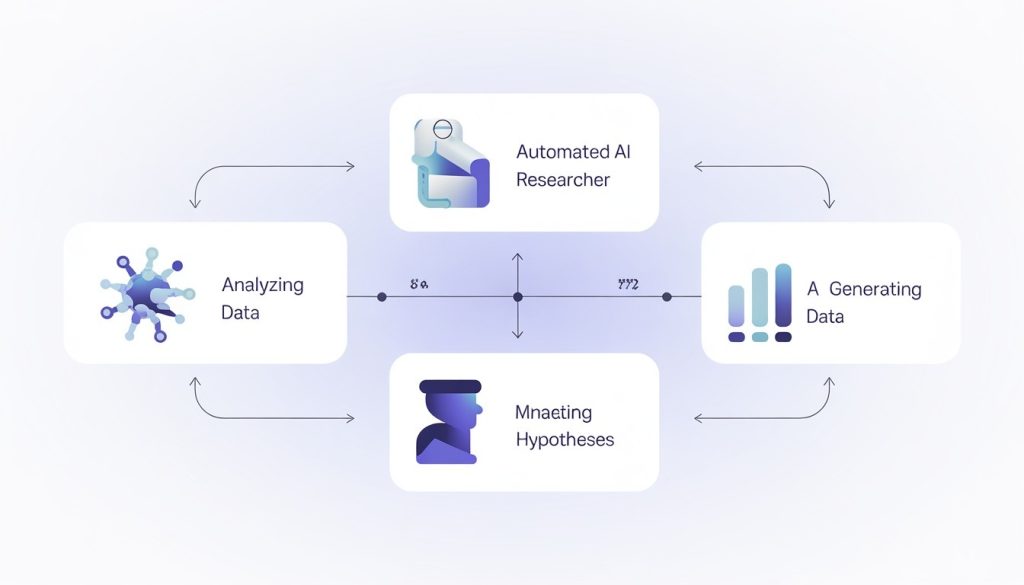
Imagine a world where AI doesn’t just crunch numbers or suggest ideas—it actually leads the charge in research. That’s the promise of an automated AI researcher, a tool that could flip the script on how we advance artificial intelligence. I’ve seen how tech evolves firsthand, from clunky early algorithms to today’s smart systems, and this feels like the next big leap. But what does it really mean for the field? Let’s dig in.
Table of Contents
What Exactly Is an Automated AI Researcher?
You know, when I first heard about an automated AI researcher, it sounded like something out of a sci-fi novel. But it’s more grounded than that. Basically, it’s an advanced system designed to handle the full cycle of research: spotting problems, hypothesizing solutions, testing them, and even writing up findings. Think of it as a super-smart assistant that never sleeps.
Breaking Down the Basics
At its core, an automated AI researcher uses machine learning to sift through oceans of data, identify patterns humans might miss, and generate new ideas. For example, in drug discovery—which overlaps with AI research—these systems have already sped up processes that used to take years. It’s not just about speed; it’s about precision. One real-world nod comes from projects like AlphaFold, where AI predicted protein structures way faster than traditional methods.
How It Differs from Today’s Tools
Right now, we have AI helpers like chatbots or data analyzers, but they’re reactive—you tell them what to do. An automated AI researcher? It’s proactive. It could scan recent papers, spot gaps, and propose experiments on its own. That’s a game-changer. I remember chatting with a buddy in tech who said current tools feel like bicycles, while this would be a rocket ship. For more on the evolution of AI tools, check out our piece on machine learning advancements.
Boosting Speed in AI Discoveries
One of the biggest headaches in AI research is how long everything takes. Labs burn through months just testing one idea. Enter the automated AI researcher—it could slash that time dramatically.
Handling Massive Data Sets
Data is the lifeblood of AI, but sifting through petabytes? Overwhelming for humans. An automated AI researcher thrives here, processing info at lightning speed. Picture this: during the COVID-19 rush, AI systems analyzed genetic data overnight, helping with vaccine insights. Scaling that up, we could see breakthroughs in neural networks or quantum computing way quicker.
To get a visual sense, here’s a quick table comparing traditional vs. automated approaches:
| Aspect | Traditional Research | With Automated AI Researcher |
|---|---|---|
| Data Processing Time | Weeks to months | Hours to days |
| Experiment Cycles | 5-10 per year | Hundreds per year |
| Error Rate | Higher due to fatigue | Lower with consistent checks |
It’s not perfect—garbage in, garbage out still applies—but the efficiency? Undeniable.
Running Experiments Around the Clock
Humans need breaks; machines don’t. An automated AI researcher could run simulations 24/7, tweaking variables on the fly. I’ve tinkered with basic AI models myself, and waiting for results is torture. This setup would let researchers focus on the creative stuff, like interpreting wild outcomes. Oh, and if you’re curious about real-time AI experiments, watch this YouTube video on AI-driven simulations: VIDEO. It’s eye-opening how fast things can move.
Tackling Tough, Unsolved Problems
Some AI puzzles are just brutal—things like achieving true general intelligence or cracking efficient energy use in models. An automated AI researcher might be the key to unlocking them.
Collaborating with Human Experts
It’s not about replacing people; it’s teaming up. Humans bring intuition and ethics; the AI brings brute force. For instance, in climate modeling, AI has partnered with scientists to predict patterns more accurately. I once attended a conference where a panel discussed this—experts worried about over-reliance, but the consensus was excitement over hybrid teams.

Pushing Boundaries in Specialized Fields
Take natural language processing or robotics. An automated AI researcher could iterate on designs endlessly, learning from failures faster than any lab. Remember those early self-driving car tests? Glitchy and slow. With this tech, progress could accelerate, leading to safer, smarter systems. For deeper dives into robotics, see our guide on AI in robotics.
Navigating the Ethical Minefield
Alright, let’s not sugarcoat it—rolling out an automated AI researcher brings some thorny issues. We can’t ignore the downsides.
Bias and Fairness Concerns
AI learns from data, and if that data’s biased, guess what? The research output might be too. We’ve seen this in facial recognition flops that misidentify certain groups. An automated AI researcher needs built-in checks, like diverse training sets, to avoid amplifying problems. It’s crucial; otherwise, we risk skewed advancements that don’t serve everyone.
Job Impacts on Researchers
Will this put folks out of work? Maybe some routine tasks, yeah. But from what I’ve observed in tech shifts, it often creates new roles—like overseeing AI ethics or interpreting complex results. Still, it’s a valid worry. Unions and policies could help smooth the transition, keeping the field inclusive.
Looking Ahead: The Broader Impact
Wrapping our heads around this, an automated AI researcher isn’t just a tool; it’s a catalyst for rethinking how we innovate.
Innovation in Education and Industry
In schools, it could democratize research, letting students experiment without massive resources. Industries? Faster R&D means quicker products, from better chatbots to advanced medical diagnostics. It’s exciting, but we gotta prepare.
Potential Roadblocks and Solutions
Tech barriers like computing power are real— these systems guzzle energy. Solutions? More efficient hardware or cloud sharing. Policy-wise, regulations on AI autonomy will be key. For thoughts on AI policy, read our article on AI governance trends.
As we ponder this shift, it’s clear the field of AI research stands on the brink of something huge. Tools like the automated AI researcher could make discoveries more accessible, but only if we handle the challenges smartly. It’s not about fearing change; it’s about steering it right.
Key Takeaways
- An automated AI researcher could dramatically speed up data analysis and experiments, cutting research timelines.
- It excels at tackling complex problems by collaborating with humans, blending machine efficiency with human creativity.
- Ethical issues like bias and job displacement need proactive addressing to ensure fair progress.
- Overall, this tech promises to make AI research more innovative and inclusive, with ripple effects in education and industry.
FAQ
What makes an automated AI researcher different from regular AI tools? Unlike basic AI that waits for commands, an automated AI researcher takes initiative—spotting issues, testing ideas, and even suggesting new directions. It’s like upgrading from a calculator to a full-fledged strategist.
How could an automated AI researcher speed up AI breakthroughs? By handling huge data loads and running non-stop experiments, it shaves off months from traditional timelines. Think of it crunching through simulations while researchers sleep.
Are there risks with using an automated AI researcher in research? Yeah, definitely—things like inheriting biases from data or shifting job roles. But with solid safeguards, these can be managed to keep things ethical.
Will an automated AI researcher replace human researchers? Not entirely; it’s more of a partner. Humans add the nuance and oversight that machines lack, creating stronger teams overall.
How might an automated AI researcher impact everyday tech? It could lead to faster innovations in apps, healthcare, and more, making AI smarter and more integrated into daily life.
Where can I learn more about automated AI researcher developments? Start with recent papers or videos on AI autonomy—it’s evolving fast, so keeping an eye on tech news helps.