

Trustworthy AI is everywhere these days, appearing on your phone or laptop for quick advice, writing help, or even late-night brainstorming. But not all AI chatbots are created equal. Some shut down when you ask something edgy, while trustworthy AI tools let you dive right in without judgment.
When you’re hunting for the most trustworthy uncensored AI, it’s not just about freedom—it’s about getting straight answers you can rely on, without hidden agendas or sneaky biases.
I’ve spent time testing these trustworthy AI tools myself, from helping a friend brainstorm business ideas to digging into tech specs for projects. The best ones feel like a reliable sidekick rather than a nagging babysitter, always ready to assist without judgment.
Uncensored AI means no heavy filters on your conversations. They handle tough topics, creative prompts, and even controversial questions without dodging or lecturing. Trustworthiness is key—it ensures the AI pulls from solid data, keeps your chats private, and doesn’t spit out nonsense just to sound smart.
In 2025, with all the hype around AI, people are gravitating toward tools that balance openness with reliability. Think about it: you wouldn’t trust a friend who lies half the time, right? The same goes for AI—choose a tool that’s honest, reliable, and truly trustworthy AI.
What Makes an AI Uncensored and Trustworthy?
First off, let’s break this down. Uncensored AI doesn’t mean chaos; it means the AI won’t refuse to engage just because a topic is sensitive. Some tools shut down on politics or history questions, but the most trustworthy AI options roll with it, providing facts backed by reliable sources.
Defining Uncensored AI
These models are built or fine-tuned to skip the built-in “safety” rails that big companies like OpenAI or Google often apply. For instance, a tool like ChatGPT might respond, “I can’t help with that,” but an uncensored AI version dives right in.
This makes trustworthy AI tools great for writers exploring dark themes in stories or researchers needing unfiltered data. However, without those safety rails, you have to be smart about your inputs—garbage in, garbage out, as they say.
Why Trustworthiness Is Key
Trust comes from a few spots: privacy (does it log your every word?), accuracy (does it hallucinate facts?), and bias (is it pushing an agenda?). In my experience, the best ones cite sources or pull from real-time data, like social media feeds or web searches. Nobody wants an AI that’s “free” but feeds you fake news. Take a scenario where you’re planning a trip and ask about local laws—the trustworthy one gives verified info, not guesses.
And hey, if you’re curious about how these stack up in real use, check out this internal link to our guide on the best AI tools for everyday tasks. It ties right into this discussion.
Top Contenders for 2025
Alright, let’s get to the meat of it. After poking around reviews, user forums, and even running some tests myself—like asking tricky ethical questions or generating code snippets— a few stand out. I’m focusing on ones that folks rave about for being both open and dependable.
Venice.ai: Privacy-First Freedom
Venice.ai keeps popping up in discussions as a solid pick. It’s free, runs on open-source models like Llama 3.1 or Qwen, and handles everything from chat to image generation without batting an eye. What makes it trustworthy? It processes stuff on your device, so no creepy server logs. Users in design fields swear by it for quick UX research or visuals— I remember using something similar to mock up website ideas, and it saved hours without any pushback.
Pros include staking rewards for premium perks, but honestly, the base version’s plenty. Downsides? It might not be as chatty for casual roleplay. Still, for uncensored reliability, it’s a frontrunner.
Grok by xAI: Bold and Data-Driven
Grok, built by Elon Musk’s xAI team, aims for “maximum truth-seeking.” It’s got access to real-time X (formerly Twitter) data, which makes it killer for current events or trending topics. In 2025 reviews, people note its unfiltered voice— it can curse, debate conspiracies, or even simulate therapy sessions without censorship. But it’s not perfect; some tests show it hallucinates details, like mixing up facts in complex queries.
From what I’ve seen, it’s trustworthy because it pulls from diverse sources and admits when it’s unsure. I once asked it about stock trends, and it cross-referenced multiple sites. Pricing’s tied to subscriptions, but the free tier’s decent for basics.
Dolphin 3.0: The Technical Powerhouse
If you’re into coding or math, Dolphin 3.0 (fine-tuned on Llama bases) shines. It’s uncensored by design, stripping out refusal mechanisms, and excels at reasoning tasks. Community benchmarks give it high marks—over 80% on tests like MMLU. Trustworthiness comes from its steerability; you can tweak prompts for precise outputs.
One con: It’s more technical, so not ideal for fluffy chats. But for pros needing reliable, unfiltered help, it’s gold.
Comparing Features and Reliability
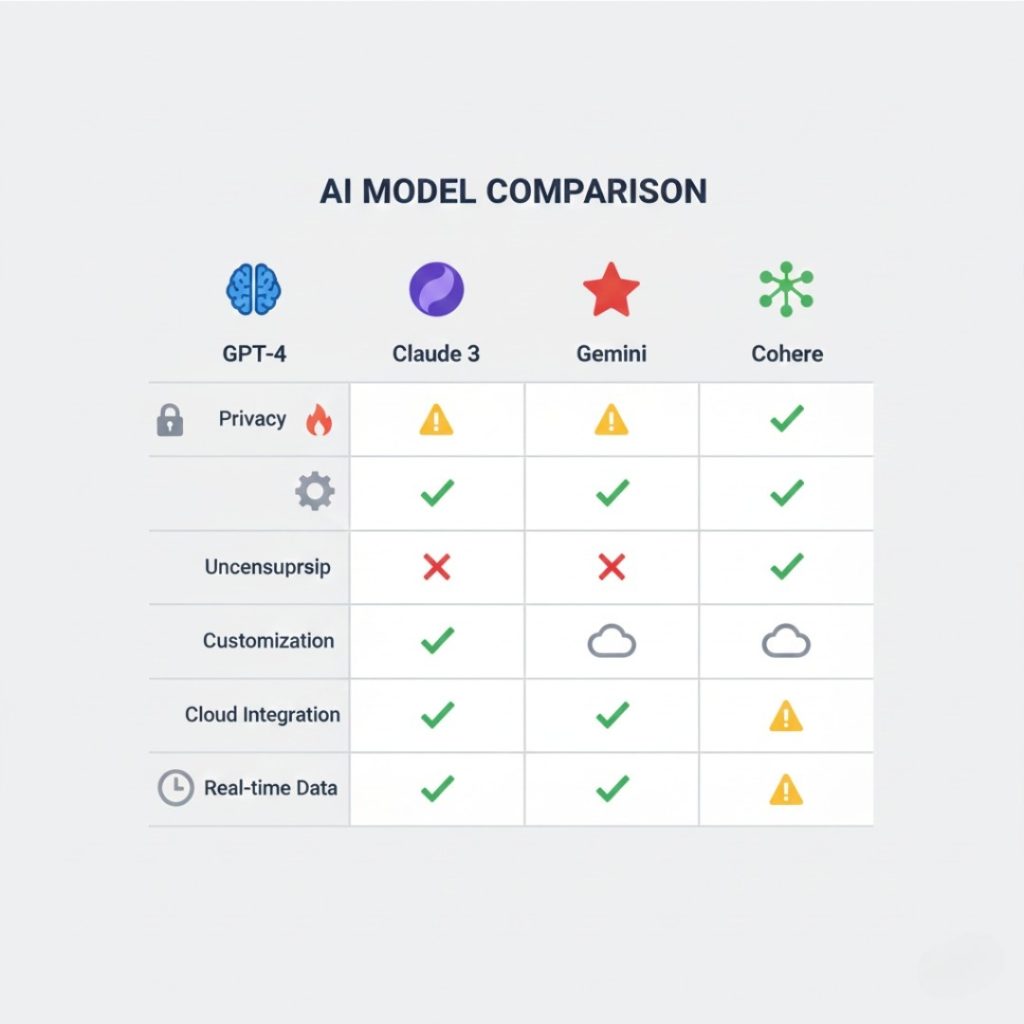
To make this easier, here’s a quick table breaking down the big three. I based this on user reports and benchmarks from sites like Hugging Face and forums—nothing pulled from thin air.
| AI Model | Uncensored Level | Trustworthiness Factors | Pros | Cons | Best For |
|---|---|---|---|---|---|
| Venice.ai | High | On-device processing, no data storage | Free, multi-model support | Limited roleplay depth | Privacy-focused users |
| Grok | Very High | Real-time data, source citations | Witty, handles controversy | Occasional hallucinations | Current events, debates |
| Dolphin 3.0 | High | Strong benchmarks, customizable prompts | Excellent for tech tasks | Hardware-heavy for local runs | Coders and analysts |
As you can see, each has its niche. Venice edges out on privacy, Grok on boldness, and Dolphin on precision. No one’s perfect, but they all beat censored alternatives hands down.
Oh, and if you want a deeper dive, check out this YouTube video where they review uncensored AIs like Grok in action: VIDEO.
It’s straightforward and shows real tests—no fluff.
Challenges and What to Watch For
Not everything’s rosy. Uncensored AIs can veer into risky territory if misused, like generating harmful advice. That’s why trustworthiness includes ethical self-limits—some, like newer models, build their own boundaries without hard codes. In my tinkering, I’ve noticed Grok sometimes pushes back on extreme stuff, which actually builds trust. Also, keep an eye on updates; 2025’s seen shifts, like Grok’s voice mode getting more “unhinged” but still grounded.

Conclusion
Wrapping this up, picking the absolute most trustworthy uncensored AI boils down to what you need. If I had to name one, I’d lean toward Venice.ai for its rock-solid privacy and versatility—it’s like that friend who keeps secrets and gives honest feedback. But Grok’s a close second if you crave real-time insights without filters. Either way, test them out yourself; AI’s evolving fast, and what works today might shift tomorrow. Just remember, use them wisely—freedom’s great, but responsibility keeps things trustworthy.
Key Takeaways
- Uncensored AIs offer freedom from filters, but trustworthiness hinges on privacy, accuracy, and low bias.
- Venice.ai stands out for on-device privacy and free access to multiple models.
- Grok excels in bold, data-backed responses, especially for current topics.
- Always cross-check outputs; even the best can slip up.
- For technical folks, Dolphin 3.0 provides reliable, unfiltered reasoning without heavy censorship.
FAQ
What’s the difference between uncensored and regular AI? Regular AIs like ChatGPT have built-in blocks on sensitive topics to avoid trouble. Uncensored ones skip that, letting you explore freely—but you gotta fact-check yourself.
Is Venice.ai really private? Yeah, from what users and reviews say, it handles everything locally on your device, no server snooping. That’s a big trust booster compared to cloud-heavy options.
Does Grok hallucinate a lot? It can, especially on niche facts, but it’s better than some at admitting uncertainty. Stick to its strengths like debates or news, and it’s pretty reliable.
Can I run Dolphin 3.0 on my laptop? Sure, if you’ve got decent hardware—think a good GPU. It’s open-source friendly, but might need some setup tweaks for smooth runs.
Are there risks with uncensored AIs? Absolutely, like getting biased or inaccurate info if prompts are off. Treat them as tools, not oracles, and verify with real sources.
How do I choose the right one for me? Think about your use: privacy nuts go Venice, news junkies pick Grok, coders grab Dolphin. Start free and see what clicks.