

- Research suggests AI could automate up to 30% of jobs by the mid-2030s, but the real shake-up starts hitting hard in 2026, with millions potentially displaced in routine tasks.
- It’s not all doom—AI might create more opportunities than it wipes out, especially in tech and creative problem-solving roles, though transitions could be bumpy for many workers.
- Evidence leans toward a mixed bag: some fields like manufacturing and customer service face big risks, while data and engineering jobs are booming, but experts stress upskilling to stay ahead.
- Controversy swirls around predictions—optimists see productivity gains leading to shorter workweeks, while critics warn of mass unemployment without policy fixes like retraining programs.
Understanding the AI Job Shift
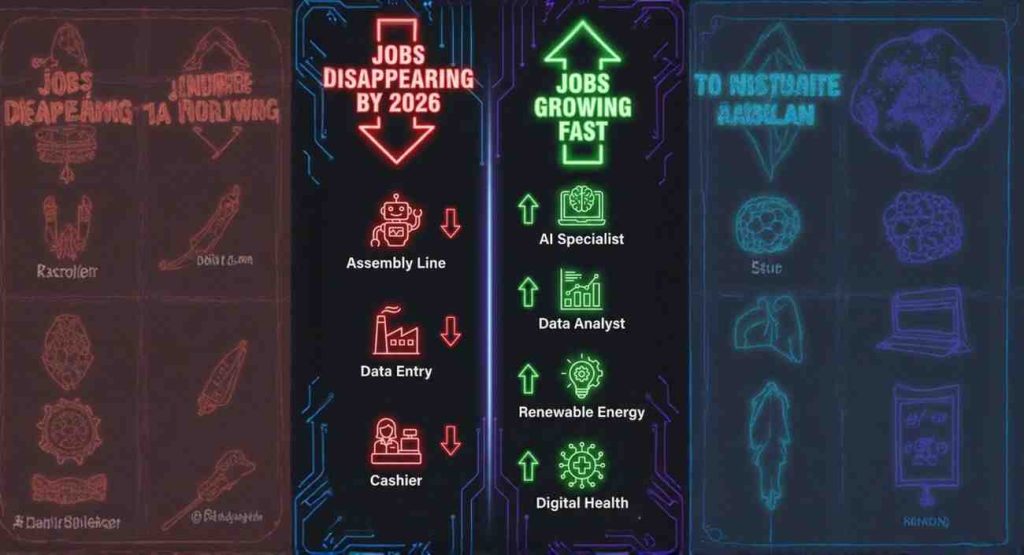
Everyone’s buzzing about AI these days, and unsurprisingly, it’s got folks wondering if their paycheck’s on the line come 2026. For instance, from what I’ve seen in my own circle—friends in retail sweating over self-checkouts—it’s a real concern. However, let’s break it down without the hype. According to reports from places like PwC and the World Economic Forum, AI is gradually reshaping the workforce, not just killing jobs outright. While it might replace repetitive tasks, at the same time, it could free people up for better work, though that’s easier said than done for some.
Preparing for What’s Coming
If you’re in a vulnerable spot, don’t panic just yet. For example, I’ve chatted with a buddy who switched from data entry to learning code basics, and as a result, he’s thriving now. So, what’s the key? Picking up skills like basic AI literacy or soft skills like teamwork that bots can’t touch. Ultimately, it’s about adapting, really.
Look, I’ve been digging into this AI thing for a while now, ever since I saw how chatbots started handling customer complaints at my old job. Admittedly, it’s fascinating but kinda scary too. With 2026 just around the corner, a lot of us are asking: will AI take away jobs? According to the numbers, yeah, some will feel the pinch, but at the same time, others could see real growth. Here, I’ll lay it out based on solid reports—no fluff, just the facts, mixed with some real-talk examples.
First off, let’s talk about the big picture. For instance, a Goldman Sachs study estimates AI could swap out the work of about 300 million full-time jobs worldwide, but at the same time, it also predicts a boost to the economy by trillions. Closer to home, in the US, the Bureau of Labor Statistics sees computer and info tech jobs growing by 26% through 2033. Now, looking at 2026, that’s when things ramp up, with 89% of HR pros in a CNBC survey saying AI will reshape roles next year. In other words, it’s not about robots stealing your desk; rather, it’s more like tools making some tasks obsolete.

The Jobs Most Vulnerable to AI Disruption in 2026
AI excels at crunching data, spotting patterns, and handling routines, which means jobs heavy on those tasks are in the crosshairs. For example, a Microsoft Research analysis via Visual Capitalist ranked occupations by how much AI could overlap with their tasks. Here are 12 that stand out as high-risk, based on exposure scores and US employment figures. I chose these because they’ve popped up across multiple sources, including MIT reports and PwC estimates.
High-Exposure Office and Service Roles
These are the everyday gigs where AI chatbots and software are already nibbling at the edges.
- Customer Service Representatives – With nearly 2.9 million jobs in the US, AI handles queries via bots like those on websites. Exposure score: 0.44. Think about how often you chat with a virtual assistant now—it’s only getting smarter.
- Telemarketers – Around 81,580 folks here, but automated calls and targeted ads are taking over. Score: 0.4. A friend in sales told me his cold-calling days are numbered.
- Receptionists – AI-like virtual assistants (remember AimeReception?) manage calls and bookings. Not ranked top, but Nexford University flags it as at-risk.
Creative and Knowledge-Based Jobs
Surprising, right? But AI’s generating text and insights fast.
- Writers and Authors – 49,450 employed; AI tools like ChatGPT draft content. Score: 0.45. It’s not replacing novelists yet, but copywriting? Yeah, that’s shifting.
- News Analysts, Reporters, Journalists – 45,020 jobs; AI summarizes news and even writes basic reports. Score: 0.39.
- Proofreaders and Copy Markers – Small field (5,490), but grammar bots do this cheap. Score: 0.38.
Data and Analysis Heavy Hitters
These involve number-crunching that AI loves.
- Accountants/Bookkeepers – AI automates data entry and audits. PwC says clerical roles like this are prime targets.
- Insurance Underwriters – Formulas and data analysis? AI’s got it covered, per Nexford insights.
- Research and Analysts – Sorting data for insights—AI speeds this up massively.
Manual and Manufacturing Sectors
Automation’s been here for years, but AI amps it up.
- Warehouse Workers – Robots locate and move packages; World Economic Forum predicts 85 million jobs like this gone by 2026.
- Manufacturing Workers – MIT says up to 2 million replaced by 2026. It’s the assembly lines getting robotic.
- Retail Workers – Self-checkouts and inventory bots reduce staff needs.
To put this in perspective, here’s a quick table of some top-risk jobs from the Visual Capitalist data:
| Rank | Job Title | Exposure Score | US Employment |
|---|---|---|---|
| 1 | Interpreters/Translators | 0.49 | 51,560 |
| 4 | Sales Reps (Services) | 0.46 | 1,142,020 |
| 7 | Customer Service Reps | 0.44 | 2,858,710 |
| 14 | Telemarketers | 0.4 | 81,580 |
| 17 | Journalists | 0.39 | 45,020 |
It’s not a total wipeout—AI might augment these roles instead of erasing them entirely. But if you’re in one, start thinking about pivots.
Jobs Poised for Growth in the AI Era
On the flip side, AI’s creating demand for folks who build, manage, and apply it. For instance, Coursera’s roundup of AI jobs shows salaries averaging over $100K, with growth driven by tools like generative AI. Here are 8 solid ones that are set to expand by 2026, according to BLS projections and expert trends.
Tech and Engineering Roles
These are hands-on with AI systems.
- AI Engineer – Builds AI apps for efficiency. Average pay: $114,420. Demand’s up as companies integrate AI everywhere.
- Machine Learning Engineer – Designs self-improving systems. Pay: $119,668. Think experimenting with algorithms—super in-demand.
- Data Engineer – Manages data flows for AI. Pay: $104,992. Every industry needs this now.
Specialized AI Fields
Niche but booming.
- Robotics Engineer – Creates bots for manufacturing and more. Pay: $107,324. With AI, robots are getting smarter.
- Natural Language Processing Engineer – Works on voice tech like Siri. Pay: $88,593.
- Computer Vision Engineer – AI for image recognition, like in security. Pay: $115,479.
Broader Support Roles
These blend AI with other skills.
- Data Scientist – Uses AI for predictions. Pay: $113,913. Forbes notes this as a top grower.
- AI Research Scientist – Develops new models. Pay: $142,325. Academic vibes, but big payoffs.
Gloat’s trends predict fast growth in tech, data, healthcare, and education roles tied to AI. It’s not just coders—think educators training on AI ethics or green tech pros using AI for sustainability.

Want a quick watch on this? Check out this eye-opening YouTube video breaking down jobs vanishing by 2026:
It’s straightforward and hits home.
How to Future-Proof Your Career
Don’t just sit there—act. For example, I’ve seen people thrive by blending human smarts with AI. Specifically, focus on soft skills like creativity and empathy, areas where AI struggles. Alternatively, dive into AI itself; after all, platforms like Coursera offer affordable courses.
For more on building AI-proof skills, check out our internal guide on essential tech upskilling: Essential Tech Upskilling for 2026.
A quote from Geoffrey Hinton, the “Godfather of AI,” really sticks with me: he warns of massive unemployment, yet at the same time pushes for policies like universal basic income to soften the blow. Honestly, it’s uncertain, but clearly, preparation beats worry.
Conclusion
Wrapping this up, AI’s set to shake things up in 2026, with some jobs on shaky ground, while at the same time sparking growth in others. In short, it’s a transition, not the end—so, stay adaptable, and you might come out stronger. Ultimately, we’ve all got to roll with it.
Key Takeaways
- AI could displace millions in routine jobs like customer service and manufacturing by 2026, but it’s more about evolution than extinction.
- Growing fields? Bet on AI engineering and data roles—they’re paying well and expanding fast.
- Upskill now: Learn basics of AI to stay relevant, no matter your field.
- Balance the hype—AI boosts productivity, potentially leading to better work-life, but watch for inequalities.
- Policy matters: Experts call for retraining to handle the shifts.
FAQ
Q: How many jobs will AI really take away in 2026?
A: Tough to pin exact numbers, but reports like from the World Economic Forum suggest around 85 million globally could shift or vanish, with the US seeing impacts in manufacturing and admin.
Q: What if I’m in a at-risk job—should I quit?
A: Not necessarily. Start adding AI tools to your workflow; it might make you indispensable. A guy I know in sales uses AI for leads and kept his gig.
Q: Are there jobs AI can’t touch?
A: Yeah, stuff needing human touch like therapy, complex leadership, or hands-on trades like plumbing. AI helps, but doesn’t replace the empathy.
Q: How do I get into a growing AI job?
A: Bootcamps or online certs are a good start, no need for a fancy degree. Check Coursera for machine learning basics.
Q: Is AI creating more jobs than it kills?
A: Seems likely long-term; McKinsey predicts a net gain, but short-term disruptions hit hard in some sectors.
Q: What’s the best way to stay updated on AI job trends?
A: Follow sites like Forbes or CNBC, they drop fresh insights regularly.
Key Citations:
- https://www.visualcapitalist.com/top-40-jobs-at-risk-from-ai/
- https://www.coursera.org/articles/artificial-intelligence-jobs
- https://www.nexford.edu/insights/how-will-ai-affect-jobs
- https://www.cnbc.com/2025/11/14/ai-to-impact-89percent-of-jobs-next-year-cnbc-survey-finds.html
- https://fortune.com/2025/12/04/godfather-of-ai-geoffrey-hinton-massive-unemployment-warning-thanks-to-big-tech-replacing-workers-with-ai-senator-bernie-sanders-bill-gates-elon-musk-predictions-probably-right/
- https://www.forbes.com/sites/bryanrobinson/2025/12/04/10-ai-predictions-for-2026-top-experts-share-new-trends/